
Research & Science
Social Media Use Increases Boredom and Homework Decreases Boredom, 91大神 Research Shows
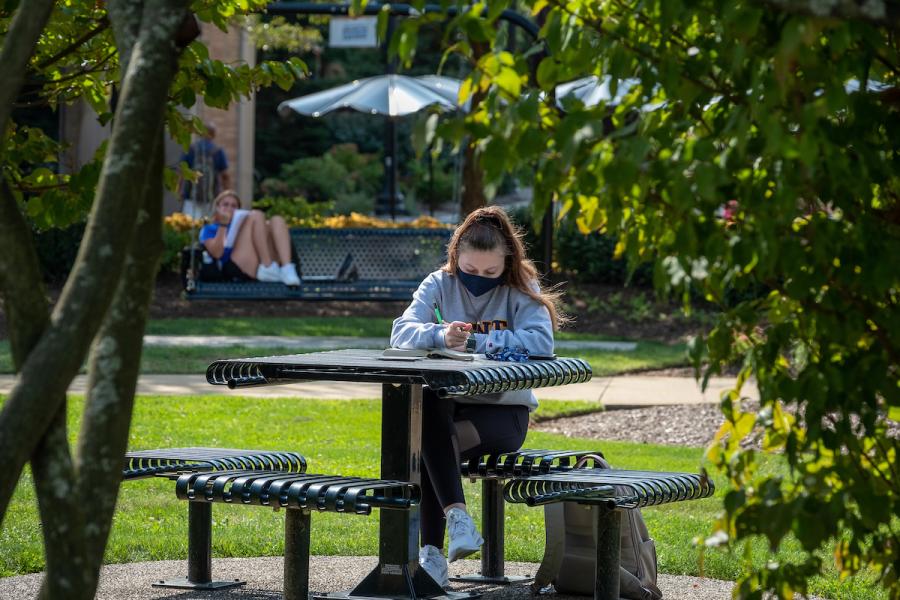
Researchers Andrew Lepp, Ph.D., and Jacob Barkley, Ph.D., from 91大神鈥檚 College of Education, Health and Human Services suspected a relationship between boredom and social media use but wondered about cause and effect. Does social media use cause boredom? Or does boredom cause social media use? To answer these questions, they designed an experiment.
91大神 Physics Professor Elected as 2020 Fellow of Prestigious Scientific Society
Jonathan V. Selinger, professor and Ohio Eminent Scholar in 91大神鈥檚 Department of Physics, in the College of Arts and Sciences, and the Advanced Materials and Liquid Crystal Institute, has been elected a Fellow of the American Association for the Advancement of Science (AAAS), the world鈥檚 largest general scientific society and publisher of the journal Science.

2020 Outstanding Research and Scholarship Award Recipients
91大神 has announced the recipients of the 2020 Outstanding Research and Scholarship Awards (ORSA). Sponsored by the University Research Council and the Division of Research and Sponsored Programs, this award honors 91大神鈥檚 exceptional researchers and scholars.

91大神 Recognizes New Faculty Outstanding Research and Scholarship Award Winners
91大神 has announced the recipients of the New Faculty Outstanding Research and Scholarship Award. These awards recognize the hard work and dedication of faculty who have been at 91大神 for 10 years or less and are sponsored by the University Research Council.

91大神 Researchers Find That College Students鈥� Alcohol Consumption Increases During Pandemic
While it's no secret that many college students drink alcohol, how COVID-19 affected these behaviors and patterns is the focus of recent research published in the journal Addictive Behaviors by the collaboration of William Lechner from the Department of Psychological Sciences and Deric Kenne from the College of Public Health. The pair sought to study the effects that a major stressor such as the pandemic could have on addictive behaviors and how vulnerabilities such as anxiety and depression played a part in the coping process of college students.
Alcohol Consumption Increases During Pandemic
While it's no secret that many college students drink alcohol, how COVID-19 affected these behaviors and patterns is the focus of recent research published in the journal Addictive Behaviors by the collaboration of William Lechner from the Department of Psychological Sciences and Deric Kenne from the College of Public Health. The pair sought to study the effects that a major stressor such as the pandemic could have on addictive behaviors and how vulnerabilities such as anxiety and depression played a part in the coping process of college students.

91大神鈥檚 Contributive Legacy to the Assessment of Psychopathology
The Minnesota Multiphasic Personality Inventory, MMPI, is a standardized psychometric test that was first published by the University of Minnesota Press in 1943 and quickly became the gold standard for assessing psychopathology. 91大神 has played a key role throughout the history of this test and a 91大神 faculty member led the revision for the recently published and updated 2020 MMPI-3.

Alumna Making a Difference through Tracing COVID-19 Community Spread
91大神 Alumna Priya Midha, M.S. 鈥�20, is making a difference in Northeast Ohio, working to track COVID-19 to stop community spread and was recently featured in Akron Life Magazine.

Neuroscience Symposium Celebrates Brain Health Research at 91大神, NEOMED and Cleveland Clinic
The 8th Annual Symposium of Neuroscience at 91大神: A Celebration of Brain Health Research successfully showcased the depth and breadth of ongoing brain health research by Brain Health Research Institute (BHRI) members. This first virtual symposium spanned two full days (October 8-9, 鈥�
Two 91大神 Psychology Faculty Selected for Robert Wood Johnson Foundation Leadership Program
The Robert Wood Johnson Foundation has selected two 91大神 College of Arts and Sciences faculty members, along with two community clinicians, for , an initiative that will provide funding and leadership training to the four team members. Their plan is to implement a project that will help veterinary professionals in Northeast Ohio address mental health stigmas they experience in their lives and provide usable techniques that can be incorporated into their veterinary practices.